
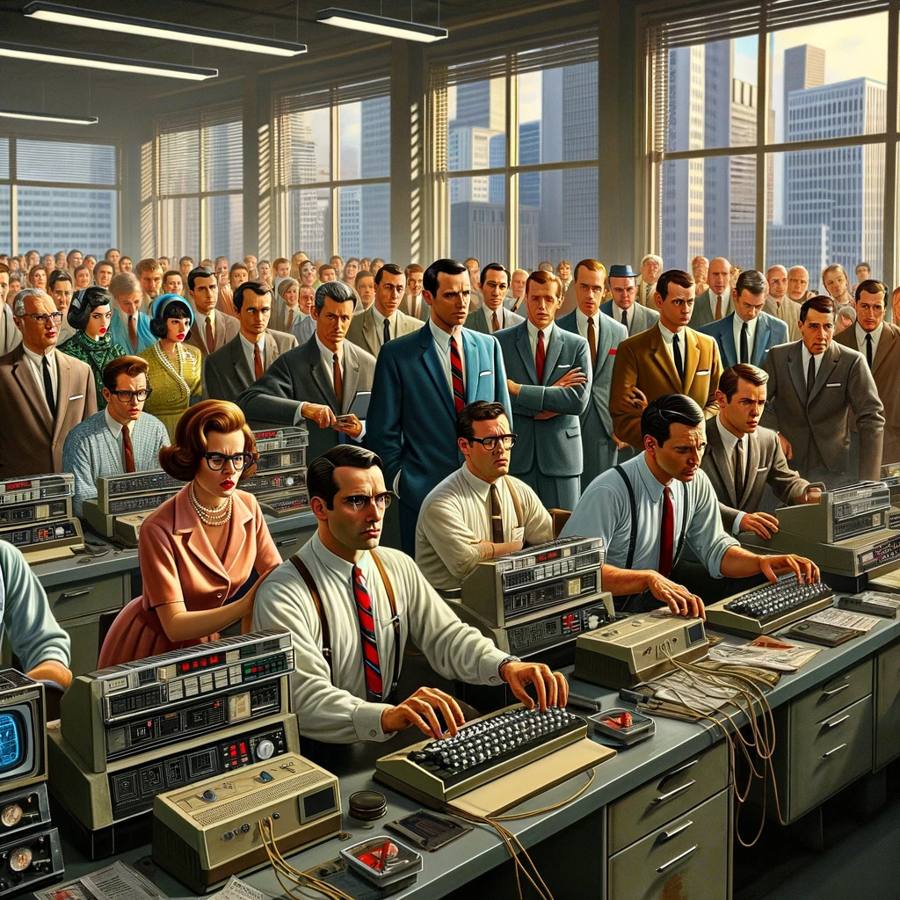
Employees drive the introduction of AI into working life. A recent report from the consulting agency Accenture shows this. A significant gap is revealed between employees' enthusiasm and managers' reluctance to embrace AI technology.
While 95 per cent of employees are enthusiastic about an increased integration of generative AI in their work, only 5 per cent of companies are prepared to follow up on this wish.
Work, workforce, workers Reinvented in the age of generative AI
The report also points out that businesses using generative AI can significantly improve productivity and growth. The prerequisite is that management must focus on value creation, build an AI-ready and secure digital core, restructure talent and working methods, ensure responsible use of AI and facilitate continuous innovation.
Changing the use of time
As much as 42 per cent of all working hours in Norway can be influenced or automated by generative AI, which considerably demands managers' competence. Furthermore, the report states that two-thirds of managers in the country need more expertise and competence in change management to realise the benefits of generative AI.
The role of management
Eighty-one per cent of respondents in the survey see technology as a powerful growth driver. Businesses that effectively apply generative AI can significantly improve productivity and growth. The prerequisite is that management puts the spotlight on value creation and builds an AI-ready and secure digital core, restructures talent and working methods, ensures responsible use of AI and facilitates continuous innovation.
The report highlights the enormous value potential that the extensive use of generative AI represents and compares the changes AI will have in working life with the industrial revolution.
Growth opportunities
According to another report from Sosialøkonomisk analyse (SØA), commissioned by NHO, Nelfo and Finans Norge, the value creation in Norway from digitisation and AI could amount to an insane NOK 5.6 trillion by 2040.
This future vision is based on expectations that generative AI alone can account for an increase of NOK 2 trillion. At the same time, other forms of advanced digital technology can contribute a further NOK 3.6 trillion. These figures underline the formidable financial gain that can be achieved by integrating AI technology nationally.
AI integration from the bottom up
While Norwegian businesses are trying to figure out how to adapt, more and more employees are taking matters into their own hands. We now see a bottom-up approach to AI, where employees rapidly teach themselves how to use new AI tools. The super-fast response to affordable access to AI tools testifies to workers' willingness to be at the forefront of technological developments.
A jagged frontline
At the same time, we now see a jagged frontier in Norwegian business's approach to generative AI. While employees are at the forefront of technological change, many in management need more understanding to follow up. This creates uneven progress, where some areas in society and some businesses quickly adapt while others risk being left on the platform.
May take time
While the report from SØA paints an optimistic picture of AI's future role in economic growth, it may be relevant to remember Amara's Law, which points out that social change often takes longer than technological development. This may mean that society's adaptation to AI may take longer than expected.
Although AI technology is developing rapidly, organisations and society may need more time to adapt to the full implications of this technology. Businesses should strive for a smoother approach, where both employee initiative and management's strategic work play a central role in ensuring effective and responsible implementation of AI.
A new type of management
In the Accenture report, reference is made to the companies' "reinventors", managers who actively reshape work processes and roles in the light of generative AI. These players proactively leverage AI to drive innovation and efficiency while building trust and collaboration.
The role of these managers will be to ensure a balanced transition to AI, where cooperation and joint strategies will be crucial to ensure that AI is an advantage for everyone and that technological progress contributes to mutual growth.
The way to cooperation
Until such a collaboration is established, businesses must arrange for employees to access AI-related training and development opportunities. They must soon open dialogue about technology's impact and future organisational role. Managers should actively seek insight from employees to understand their perspectives and experiences with AI. In contrast, employees should be encouraged to share their knowledge and contribute to shaping the company's AI strategy.
Are you interested in the connection between AI and working life? Get my previous newsletters on the topic:
Be a driving force: 15 tips for how you as an employee can introduce AI thinking in your workplace.
Gen X: Steering the Course of Work in the AI Era, Embracing its Irony
AI, Communication, and the Dawn of the Creative Generalist
About me
My name is Kari Andresen. I specialise in technology, science, and health. My professional journey into artificial intelligence includes a period from 2016 to 2021, where I led the communications for the Norwegian research and development project DoMore!, which focused on AI-based cancer diagnosis.
Use of AI
The illustrations for The Creative Nexus are created using the AI tools Midjourney and Dall-E based on my orders and choices. Although AI tools greatly help, my ideas, human judgment, and professional insight govern the final content.